 Semi-Autonomous Surface Vessel
Problem statement
Researchers, educators, and students often face limitations when deploying vessels into unsafe, remote, or difficult-to-access waters due to the need for constant human oversight. Autonomous surface vessels (ASVs) offer a solution by enabling operations in these conditions without direct supervision. However, existing ASVs are primarily designed for industrial or military applications and are prohibitively expensive for educational purposes. For example, the Clear path Robotics Heron USV is priced between $35,000 and $40,000. Open-source alternatives are available, but they frequently lack robustness, adaptability, or real-world testing, limiting their usefulness in hands-on learning environments. Our project addresses these challenges by retrofitting a commercially available remote-controlled boat into a semi-autonomous surface vessel capable of collecting four colored buoys within a 10 m – 10 m outdoor water environment. With a target budget of $5,000, the prototype aims to balance affordability with functionality, integrating navigation sensors, environmental monitoring, propulsion control, and real-time algorithms. This approach allows students, educators, and hobbyist researchers to gain practical experience with autonomous maritime systems, bridging the gap between classroom theory and real-world implementation. Beyond educational users, this low-cost solution also benefits institutions, makerspaces, and research labs by providing a scalable, safe, and accessible platform for experimentation, prototyping, and environmental monitoring without the high costs or logistical challenges associated with full-scale commercial ASVs.
Team members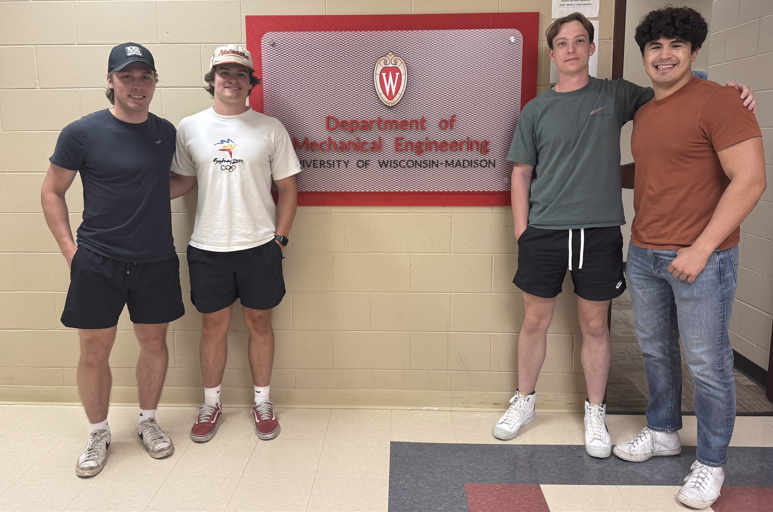
Colby Milligan – facilitator
Cade Murphy – accountant
Kevin Sanz – admin
Marcus Vittone – communicator
Client
Aaron Messenger
Fincantieri