BERR Exo
Dynamically Loaded Resistive Arm Exo-skeleton
Problem statement
Physical therapy patients recovering from arm injuries often struggle with resistance tools that fail to match the arm’s natural strength curve, making exercises painful, inconsistent, and discouraging. Therapists rely on subjective pain scales and manual adjustments, while patients often feel discouraged when progress is slow and hard to perceive. While assistive exoskeletons and smart fitness systems exist, they typically focus on support rather than dynamic resistance and lack real-time feedback or safety controls, leaving a critical gap in rehabilitation technology [1]. Our solution, a wearable exoskeleton using magnetorheological braking, builds on proven MR brake research to deliver dynamically adjustable resistance with sensor based tracking of torque, tempo, and range of motion [2]. By addressing both emotional and clinical needs, we empower patients with precise, trackable progress and therapists with scalable, data-driven care.
[1] Department of Health, State Government of Victoria, Australia, ‘Resistance training ‘ preventing injury,’ Better Health Channel, Sep. 2024. https://www.betterhealth.vic.gov.au/health/healthyliving/resistance-training-preventing-injury
[2] R. Jinaga, J. Thimmaiah, S. Kolekar, and S.-B. Choi, ‘Design, fabrication and testing of a magnetorheologic fluid braking system for machine tool application,’ SN Appl. Sci., vol. 1, no. 4, p. 328, Mar. 2019, doi: 10.1007/s42452-019-0236-7.
Team members
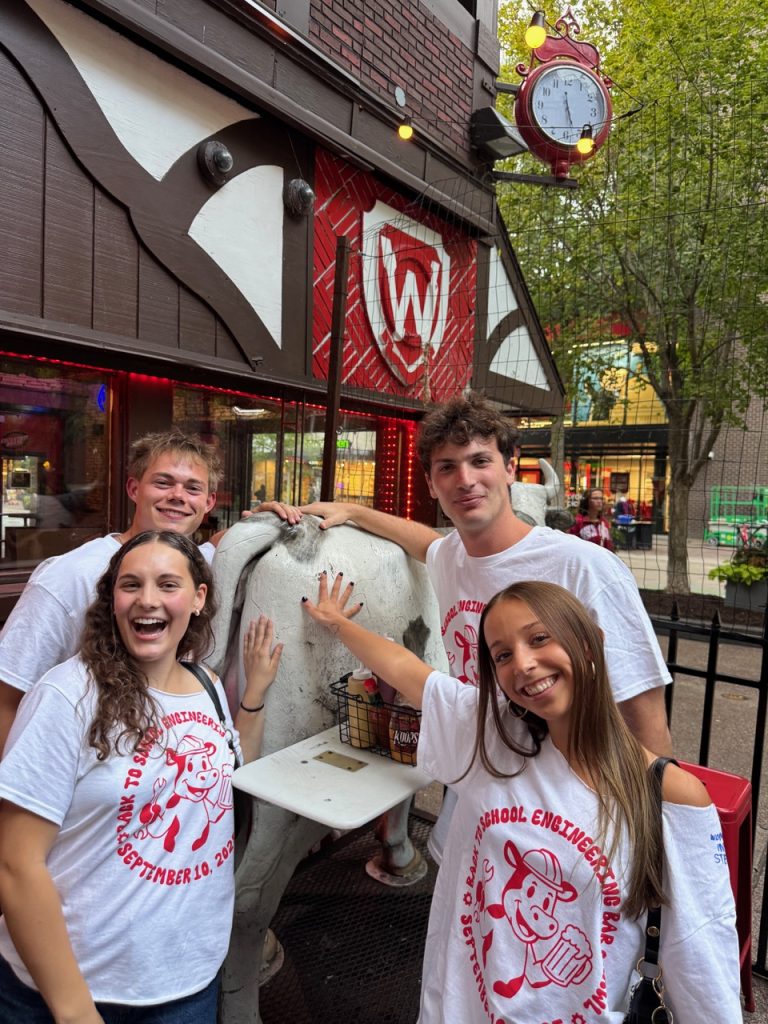
Ben Levy – facilitator
Eliza Robinson – communicator
Rory Koperski – accountant
Ryan Hogan – admin
Client
Ryan Hogan
UW – Mechanical Engineering