Badger Bike Dynamics

Mechanical Test System for Simulating Rider Forces on Bicycles
Problem statement
Bicycle testing in laboratory settings traditionally isolates the frame and components, overlooking the dynamic interaction between the rider and the bike. In real-world conditions, the human body introduces a mass-spring-damper system that significantly alters how the bicycle responds to bumps, vibrations, and steering inputs. Without accounting for these coupled dynamics, lab results risk being incomplete or misleading, limiting Trek’s ability to optimize comfort, safety, and performance for riders. Although engineering research provides approximate values for human body dynamics, there is no standardized and repeatable mechanical substitute for a rider that can be integrated into Trek’s existing testing systems. To address this gap, our project will design and prototype an adjustable spring-mass-damper system that accurately simulates the forces exerted at the saddle, handlebars, and pedals. This will enable Trek to achieve more repeatable and impactful lab testing outcomes.
Bicycle testing in laboratory settings traditionally isolates the frame and components, overlooking the dynamic interaction between the rider and the bike. In real-world conditions, the human body introduces a mass-spring-damper system that significantly alters how the bicycle responds to bumps, vibrations, and steering inputs. Without accounting for these coupled dynamics, lab results risk being incomplete or misleading, limiting Trek’s ability to optimize comfort, safety, and performance for riders. According to Trek representative Wendy Ochs, engineering research provides approximate values for human body dynamics, but there is no standardized and repeatable mechanical substitute for a rider that can be integrated into Trek’s existing testing systems. If Trek would continue testing with a live person, countless hours of human resources would be wasted. The tester will lose full days of work, and to avoid live testing, the research and development team will go longer without validation of prototypes. Additionally, Trek will be limited to testing under one load condition; all humans are different, which will result in products optimized to one rider. To address this gap, our project will design and prototype an adjustable spring-mass-damper system that consistently and accurately simulates the forces exerted at the saddle, handlebars, and pedals. This will enable Trek to achieve more repeatable and impactful lab testing outcomes. Additionally, this solution will have adjustable mass allowing tests with different weights, accommodating for different people rather than a single test subject. Finally, having a mechanical system will allow for frequent testing without human capital wasted.
Team members
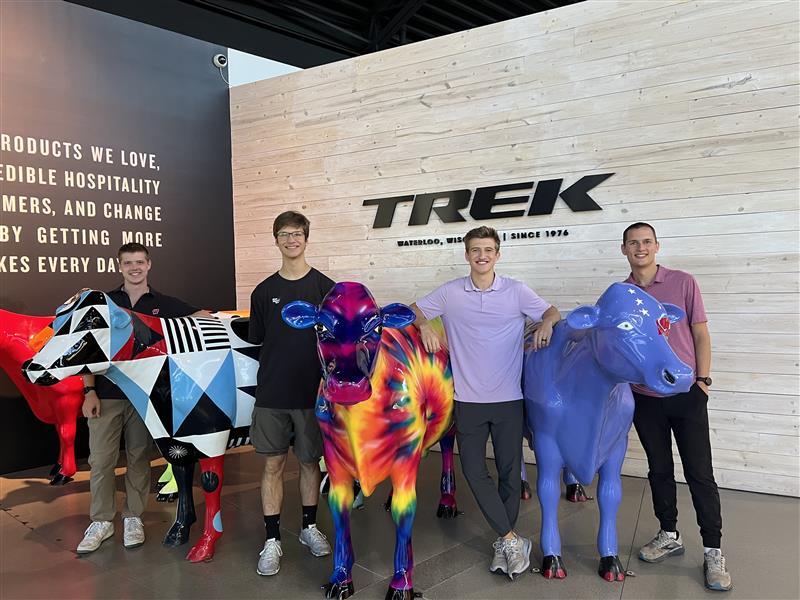
Alexander Staskiewicz – facilitator
Braden Marks – accountant
Matthew Hosmann – communicator
Owen Brown – admin
Client
Wendy Ochs
Trek Bicycle Company