Robotic Arms
Integration of instrumented spatial linkage for control of robot arm during biomechanical testing
Problem statement
Robotic arms are widely used in biomechanical testing of human joints because they allow precise and repeatable motion over large ranges. However, their compliance makes it difficult to achieve accurate control, which can lead to significant errors in joint and ligament force measurements [1]. For example, compliance-induced inaccuracies may cause researchers, such as our client, to misinterpret forces by as much as 100 N for specific joint applications, leading to unreliable results in medical device testing, implant design, and treatment planning; all fields that require high levels of data accuracy. Traditional solutions, such as optical motion capture, also introduce error and rely on line-of-sight tracking, which is impractical in many testing setups. A more robust solution is to directly track the motion of bones using an instrumented spatial linkage (ISL), which avoids line-of-sight issues and provides highly accurate data for use in research applications. Validating this system and integrating it with a Tormach robotic arm controlled by ROS will provide biomechanists with an accessible and precise testing platform, improving the reliability of research and clinical outcomes.
[1]
C. M. Gillespie, N. J. Haas, T. F. Nagle, and R. W. Colbrunn, ‘ANALYSIS AND IMPLICATIONS OF COMPLIANCE IN JOINT BIOMECHANICS SUPERPOSITION TESTING,’ bioRxiv, p. 2024.12.10.627572, Jan. 2024, doi: 10.1101/2024.12.10.627572.
Team members
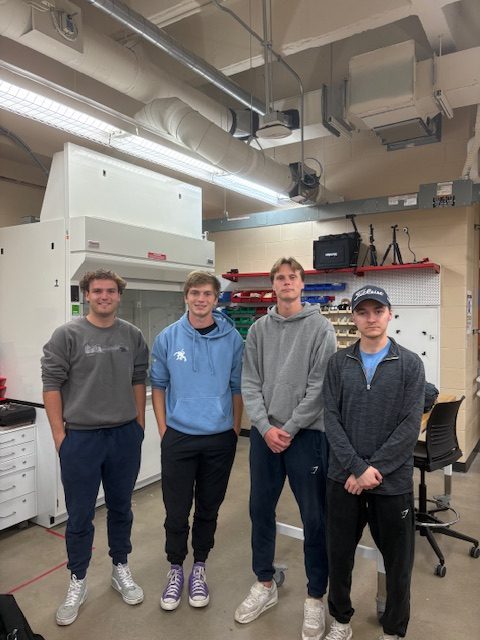
Duncan Fransdal – admin
Joseph Hanson – facilitator
Max Heirigs – accountant
Zachary Johnson – communicator
Client
Josh Roth
UW – Mechanical Engineering