AeroFloat
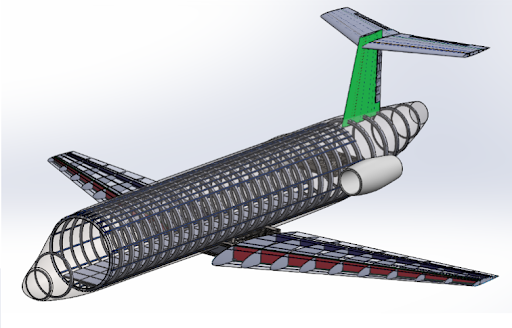
AeroFloat is a purpose-built aircraft for commercial and research zero-gravity flight, intended to provide a more accessible and ergonomic alternative to heavily modified retired aircraft currently used for parabolic flight. The design targets more than 20 seconds of microgravity per cycle while remaining smaller than existing zero-g aircraft, capable of flying near Mach 0.7 with a 3,000-pound payload, and able to withstand periods of 2 g loading with a global structural factor of safety of 1.25. The mission consists of repeated parabolic trajectories with carefully controlled entry, zero-g, and recovery phases, requiring precise flight mechanics and strong longitudinal and lateral stability. The team selected twin HTF 7250 engines and developed the wing, empennage, fuselage, wingbox, engine mounts, and other primary structures around the unusual loading environment. Finite-element analyses were used to evaluate critical components including the wingbox and engine thrust fixture, with minimum factors of safety meeting or exceeding the project requirement. The design also addresses wing and empennage loading, skin buckling, fuselage bending and shear, and overall aircraft stability. By tailoring the aircraft’s aerodynamics, structure, propulsion, and configuration specifically for parabolic flight, AeroFloat seeks to increase zero-g duration while improving stability, crew comfort, and the versatility of microgravity flight operations.
Team Members
Jiayan Zhang
Jon Greupink
Jaden Anderson
Joe Finato