Lunar Lyft
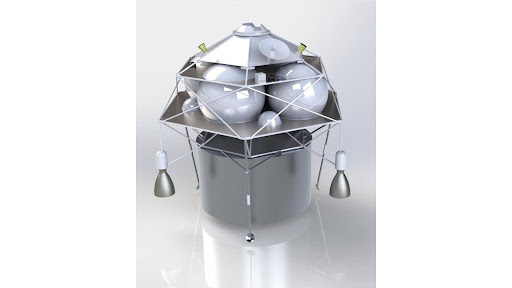
Lunar Lyft is a reusable lunar cargo lander designed to transport up to 2,500 kg of non-human payload between the Lunar Gateway and the lunar South Pole. The mission begins with launch from Earth to low Earth orbit, followed by trans-lunar injection and transfer to low lunar orbit, where the vehicle descends to the South Pole to deliver cargo. After completing its surface mission, Lunar Lyft launches back into low lunar orbit, transfers to the Gateway’s near-rectilinear halo orbit, and rendezvous with the station for refueling and reloading. The design is intended to operate for 50 cycles with minimal human intervention, placing strong emphasis on reusability, autonomous operation, and robust landing hardware. The team selected a VRM5500-H engine using hydrazine and MON-3 propellants and developed the vehicle’s propulsion, plumbing, instrumentation, primary structure, docking system, payload bay, and landing legs. The total vehicle mass was sized to approximately 45,500 kg, just below the stated SLS Block 2 payload limit, with the majority of the mass allocated to propellant. Landing legs were designed for repeated lunar touchdowns, and the project identified modal analysis, actuator integration, trajectory simulation, and multidimensional landing-vibration modeling as important areas for future refinement.
Team Members
Jack Gronseth
Ian Hoffman
Julia Thormann
Matteo Tonelli