AeroAid
Rapid-Response UAS for Winter Wilderness Medical Delivery

Problem statement
Deploying reliable overhead illumination during nighttime emergency response and field operations remains a severe logistical challenge. Traditional light towers deliver sufficient illumination, but they are heavy, difficult to haul, and require lots of time to set up. Commercial tethered light drones provide sufficient lighting coverage, but above $25,000, they are completely out of reach for volunteer rescue crews, small contractors, and everyday consumers [1]. As a result, people working after sunset stumble through dim, shadowed conditions, or haul in loud, bulky gear [2]. There is an urgent need for a portable, user-friendly aerial lighting system that makes overhead light accessible. Suspending a light source directly overhead eliminates the glare and shadows. To work comfortably around people, the system must be quiet enough that crews can carry on conversation. While a drone hovering overhead raises safety concerns, the entire kit packs down to just 15 pounds, has an impact-safe profile that avoids injury during accidental drops, and an autonomous descent program that reels the craft down safely in emergencies [3]. Delivering three hours of continuous, quiet tethered flight, this design bridges the gap between dangerous darkness and overpriced commercial rigs. References: [1] Candrone / Elistair, “Safe-T 2 Tethered Drone Station Specifications and Commercial Pricing,” Candrone Commercial Fleet Systems, 2024. [Online]. Available: https://candrone.com/products/elistair-safe-t-2-tethered-drone-station [2] Occupational Safety and Health Administration (OSHA), “Safety and Health Regulations for Construction: Illumination,” U.S. Department of Labor, Standard 29 CFR 1926.56, 2019. [Online]. Available: https://www.osha.gov/laws-regs/regulations/standardnumber/1926/1926.56 [3] M. Tognon, C. Gabellieri, R. Naldi, and A. Franchi, “Tethered aerial vehicles: A review of modeling and control perspectives,” IEEE Transactions on Robotics, vol. 38, no. 5, pp. 3177–3196, 2022.
Team members

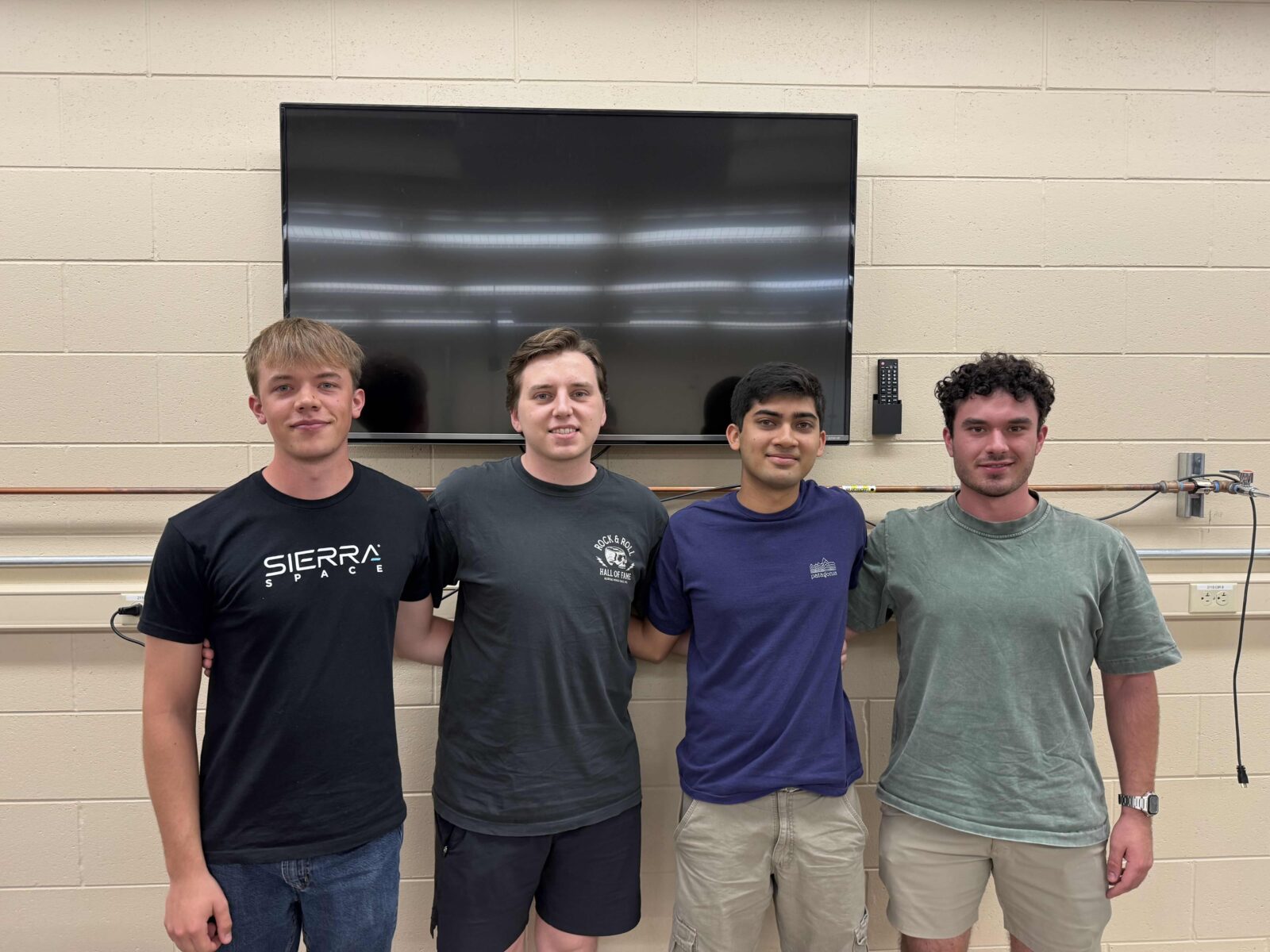
Dhruv Jhaveri – admin
Jack Kashuk – accountant
Leo Stiffler – communicator
Theodore Robisch – facilitator
Client
Lennon Rodgers
UW – DI Lab