Wave Crashers
Wave Generator
Problem statement
Imagine getting the chance to invest in a large-scale educational tool that will give students the chance to gain a deeper understanding of the topics they care about; that’s what’s happening in the mechanical engineering department next year with a 5-meter wave flume to help teach a class on wave energy. However, this flume does not have the proper means to measure the waves it creates. This makes it so students can not find the exact correlation between the wave energies they are learning about and the properties of the generated sine waves. The lack of a built in measurement system also makes it so there are no current solutions available. The goal of this project is to integrate sensors that already exist with the flume to display the wave properties. To do this, measurement methods will be implemented on a small-scale flume that students before us have built and then transferred to the larger flume. The reason why measurement solutions need to be tested on the small flume is because the larger flume will not be bought with enough time to find an effective measurement system before the fall 2028 semester. Along with adding a measurement system, the absorbing beach and wave generator in the small scale flume will be improved. The wave generator type will be kept the same since the plunger type generator it uses is able to work while being completely surrounded by water and generates little to no back waves [1]. The plunger block shape will be changed since the current shape is not optimized to generate consistent sine waves. To improve the absorbing beach, both its material and shape will be changed. These properties are important because they are crucial to minimizing the interference from the bounce back of older waves [2] which is necessary to get proper measurements. An argument against this project is that the generated waves do not fully represent the waves students would encounter in the real world. However, the use of these flumes can give students a starting point for understanding the principles of wave energy which can then be applied to the complex waves of the real world. Once the improvements are completed and the measurement system is found and placed on the larger flume, the small scale wave flume can be used at outreach events. At these events, like engineering EXPO, kids can be inspired to pursue engineering and wave energy development that the flume would show, with them possibly taking the class that uses the 5m flume. That inspiration can come from kids and undergrads gaining a better understanding of wave energy and the effects its development can have on society. Once the students who have taken the class go off into the world, they can start shifting our energy usage away from fossil fuels and towards the clean energy that is found in ocean waves based on the principles they were taught.
Team members

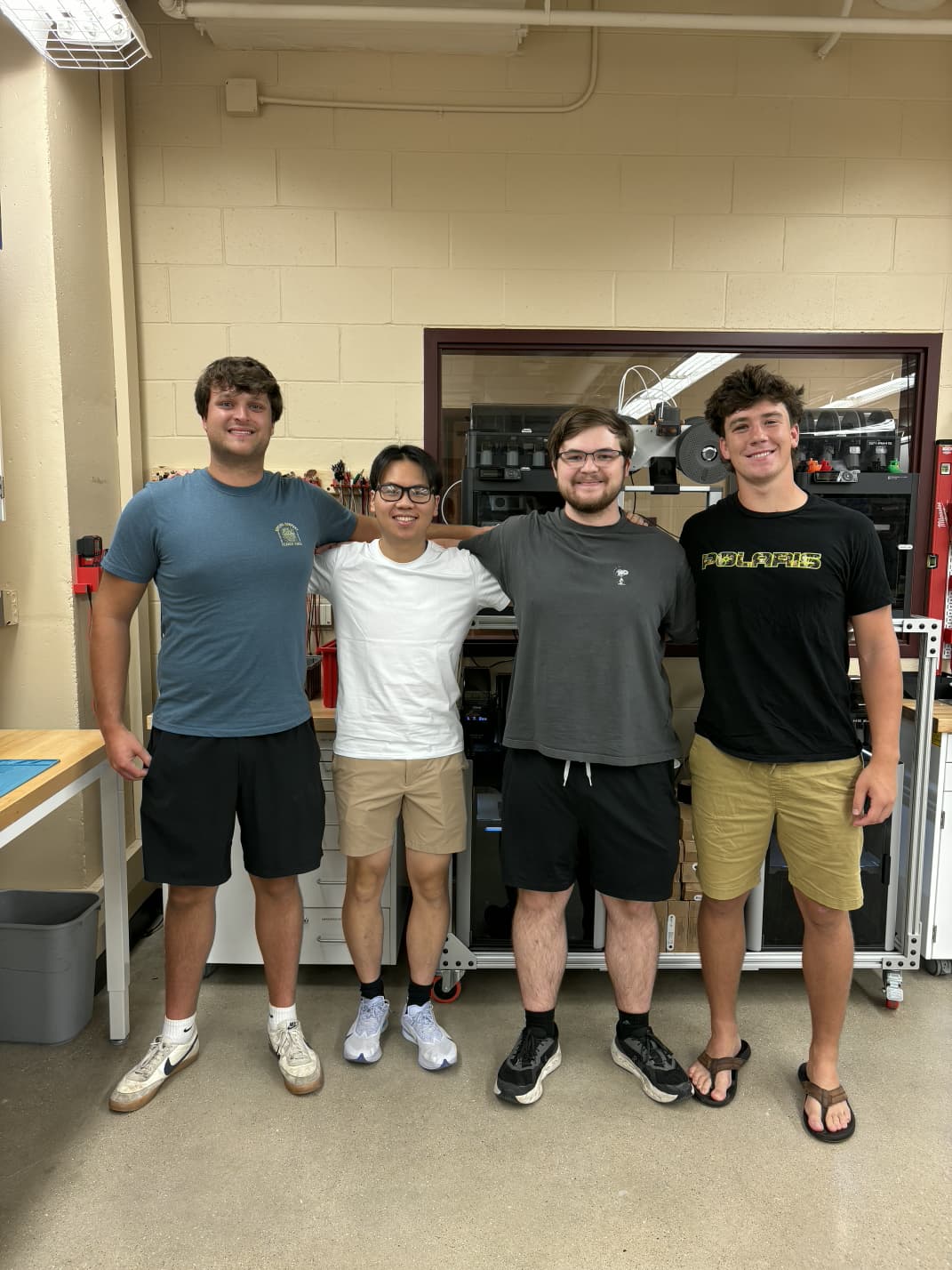
Audric Buslim – admin
Emmett Krueger – communicator
Joseph Garczynski – facilitator
Noah Kestner – accountant
Client
Arganthael Berson
UW – Mechanical Engineering