Scuttle Mission
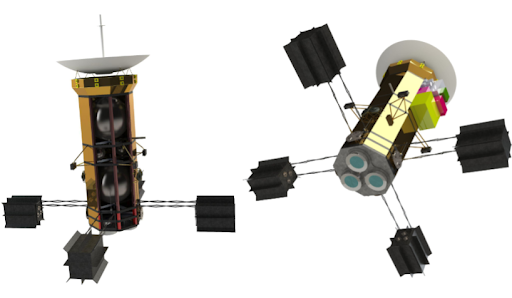
Scuttle Mission is a deep-space spacecraft concept designed to explore Ariel, one of Uranus’s moons, and return scientific data using imaging and other sensing instruments. The project focuses on making a very long-duration outer-planet mission practical through highly efficient electric propulsion rather than relying solely on conventional chemical propulsion. The team evaluated an electric-propulsion trajectory from low Earth orbit to Earth escape and then onward to Uranus, comparing the results with a chemical impulsive-transfer approach. Their analysis showed that electric propulsion could dramatically reduce propellant mass, although at the cost of a long mission duration, with the Earth-to-Uranus leg taking roughly 19.5 years. The spacecraft design addresses structural, thermal, power, communications, propulsion, and shielding requirements associated with the mission, including launch loads of 8 g axially and 3 g laterally. Structural analyses considered the fuel tanks, high-gain antenna supports, radioisotope power-system supports, spacecraft frame, and release mechanisms, while thermal work addressed radioisotope heat transfer, launch-vehicle heating, and radiation shielding. The resulting concept draws on heritage from missions such as Dawn, Voyager, and Cassini while adapting electric propulsion and spacecraft systems for an ambitious mission to Ariel.
Team Members
Matthew Brandt
Olivia Janson
Chase Orvis
Kaden Reybrock