WECky Warriors
Wave Energy Converter for Undergraduate Laboratories

Problem statement
Wave Energy Converters are a type of device used to harness the kinetic and potential energy of waves in a large body of water and turn it into usable electricity. While there are a large variety of working prototypes out there, this is a relatively new technology and as such, an ‘ideal’ type of device has not been established. Most current designs feature a floating buoy system that is anchored into the sea floor, but this raises concerns about environmental impacts due to deep ocean drilling, noise pollution, and vulnerability to salt water corrosion. Wave energy conversion is also a “hugely varying stochastic process due to diffraction and radiation”, (sciencedirect.com) and therefore is heavily dependent on both the device used, and the conditions present. While we have the ability to fix some variables like the wavelength and frequency within our body of water, we may still have to deal with random variables like wind speed or temperature, based on how our experiments are set up. Regardless, it is estimated that if a type of power generation like this become widely used, “an estimated 29,500 Terawatt-hours of energy could be produced from ocean waves” (ipcc.ch). Combining that with data that suggests that waves are both more predictable, and posses a larger potential energy output than solar energy proves that this is a project worthy of pursuing. Our goal for this academic year will be to create a working prototype of a wave energy converter with varying parameters such that an undergraduate lab will be able to explore the energy production of a real world system. This lab will be integrated into a new course on marine energy hosted by UW Madison’s Mechanical Engineering department, and funded by the DOE.
Team members

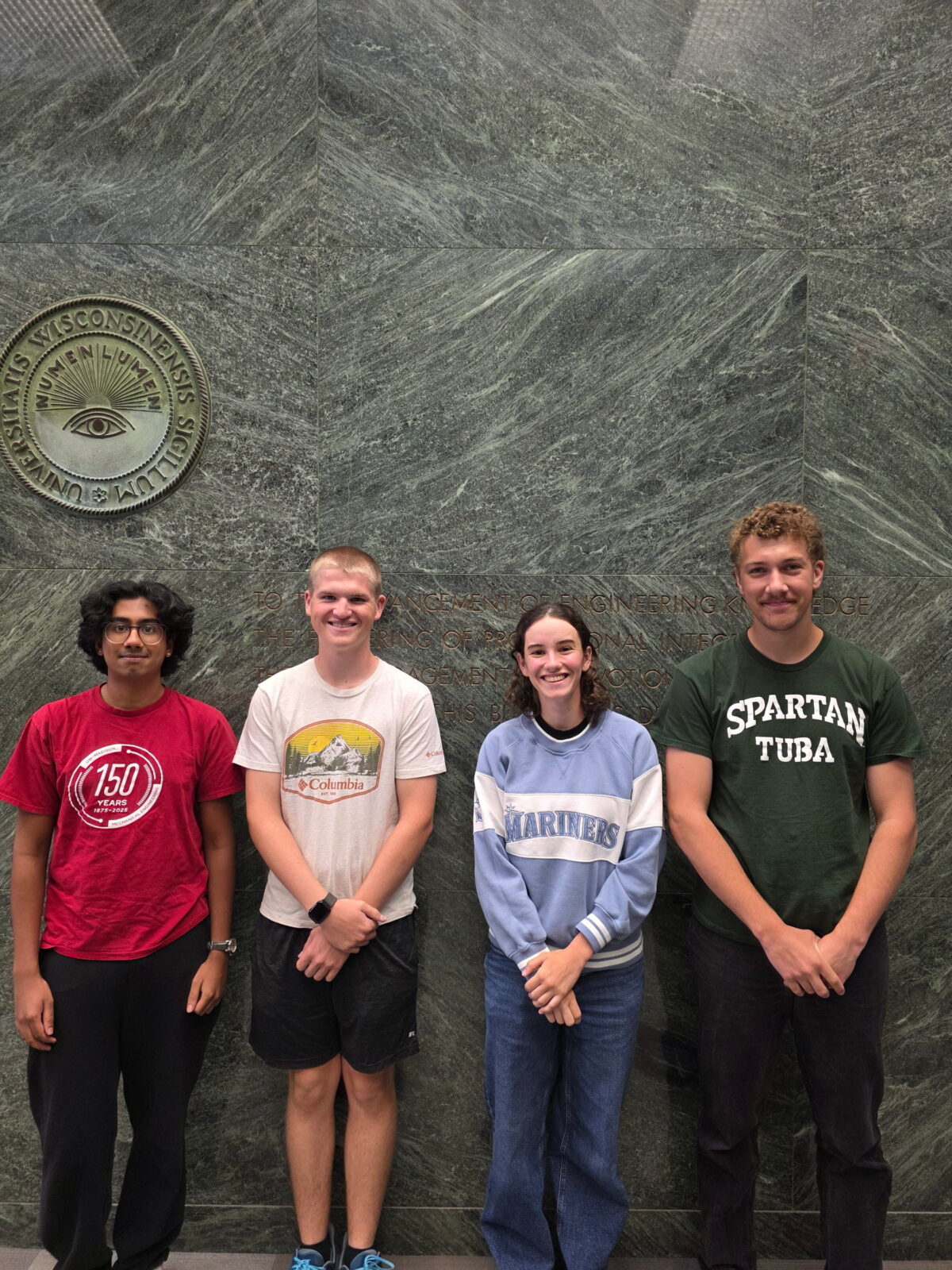
Rithvik Aligireddy – communicator
Jozef Kralovec – facilitator
Jaden Zuk – admin
Zoe Gureno – accountant
Client
Arganthael Berson
UW – Mechanical Engineering