It’s so Rover
Wisconsin Robotics Swerve Drive Development
Problem statement
Wisconsin Robotics competes yearly in the University Rover Challenge (URC). It is a worldwide rover competition that takes place at the Mars Desert Research Station in Hanksville, Utah. The competition is becoming increasingly competitive, with the winning team scoring 470 out of a possible 500 points [1] and the missions have been changed to put an even greater emphasis on navigating difficult terrain [2]. In order to stay competitive, Wisconsin Robotics needs to make large scale improvements to the rover. One major area Wisconsin Robotics lags behind is the drive system. The previous winning team claims driving speeds of over 30 mph, while WR maxes out around 4 mph. Additionally, current tire treads struggle in desert terrain, incremental encoders make swerve control difficult, and our system has relatively low torque compared to competitors. An improved drive system will help all areas of the team, allowing for more accurate arm manipulation, allow the software team to focus less on obstacle avoidance, and give more time for the team to complete competition missions. Additionally, tackling the entire drive system in one project will allow for more cohesion than previous years drive systems that were broken up into smaller projects for newer members of the team. The drive system project has several key objectives to meet our clients goal of providing a drive system that will allow Wisconsin Robotics to meet the competition. First, the team must produce a functional prototype of the swerve-drive mechanism by the end of the semester. This is to ensure that the team will be ready for Systems Acceptance Review (SAR) at the end of February. Second, the system must meet several performance benchmarks (speed, torque, weight). This is to ensure that the system produced will be an improvement on previous designs. Finally, the design must follow Design for Manufacture and Assembly principles. This will allow for simple manufacturing and troubleshooting, which will save the team valuable time best reserved for testing the rover. Our team has a plan to accomplish the listed objectives by the end of the semester. The team will complete all necessary design specifications by 9/25. The team will complete a preliminary CAD model of the swerve-drive mechanism, including full motor and bearing selection, by 11/6. The team will complete the final working prototype by 12/11. All listed deadlines are reasonably achievable by the team, and should allow plenty of time for the system to be tested prior to when it will need to be deployed on the rover. [1]“URC2026 Scores,” Marssociety.org, 2026. https://urc.marssociety.org/home/about-urc/history/urc2026/urc2026-scores (accessed Sept. 25, 2026). [2] “Requirements & Guidelines,” urc.marssociety.org. Accessed: Sep. 25, 2026. [Online]. Available: https://urc.marssociety.org/home/requirements-guidelines
Team members

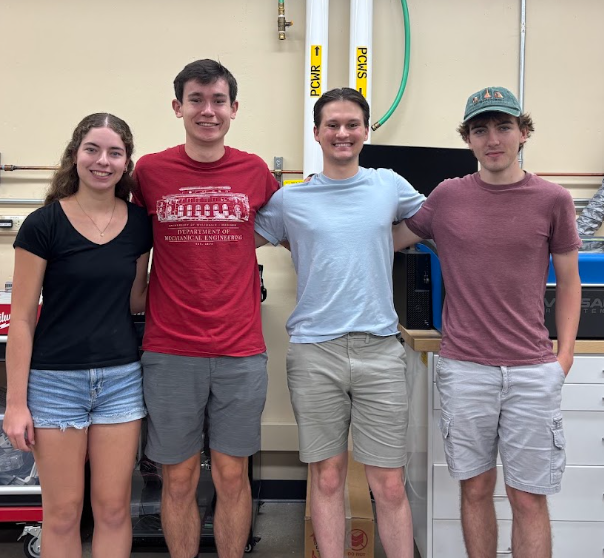
Aaron Larson – admin
Amelia Stalter – facilitator
George Vandersluis – communicator
Luke Olson – accountant
Client
Devansh Gupta
Wisconsin Robotics